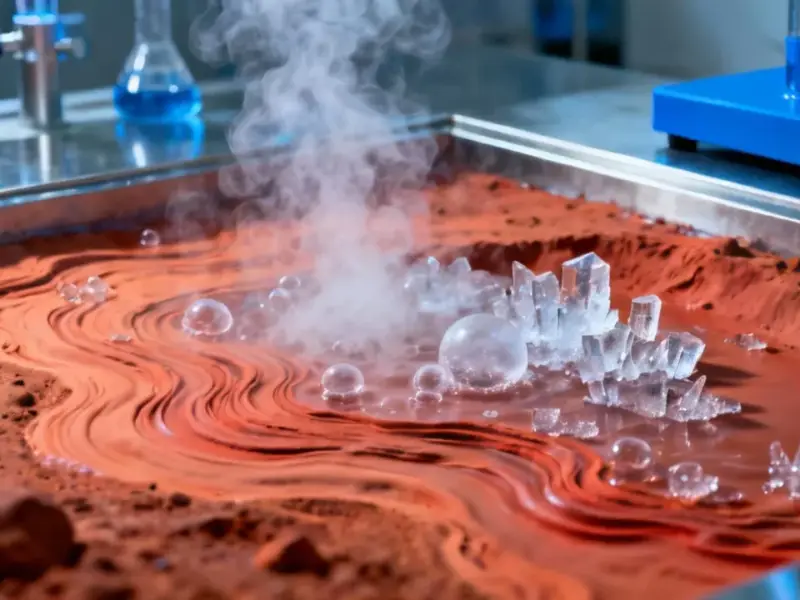
According to Futurism, NASA’s Perseverance rover has captured the first direct evidence of electric discharges, or sparks, occurring within dust devils on Mars. The findings, detailed in a new study in the journal Nature, come from an instrument microphone that recorded 55 distinct electrical disturbances since the mission began in 2021. Crucially, 16 of those events happened when a dust devil passed directly over the rover. Lead author Baptiste Chide explained that Mars’s thin atmosphere lowers the charge threshold needed for sparks compared to Earth. This confirmation ends a long scientific hunt for Martian lightning and suggests these discharges could alter the planet’s surface chemistry.

A Lucky Break with a Microphone
Here’s the thing: they weren’t even looking for this. The SuperCam microphone was designed to listen to the “pings” of rocks being zapped by a laser for chemical analysis. But it kept picking up these weird pops and crackles. Basically, it stumbled onto a whole new field of Martian meteorology. The real clincher was the correlation—those 16 events timed perfectly with dust devil passages. And because the spark rate didn’t spike during bigger dust storms, the team could pin the blame squarely on the devils. It’s a fantastic example of a scientific instrument doing something it was never designed to do, just because it was there and listening.
Why Mars is a Static Electricity Paradise
So why does this happen more easily on Mars? Chide nailed it: the thin atmosphere. On Earth, our thick air acts as an insulator; you need a massive build-up of charge, like in a thundercloud, to overcome it and create a spark. Mars’s atmosphere is about 1% as dense. It’s a much weaker insulator. So when all that fine, abrasive dust grinds together inside a whirlwind, the triboelectric charging doesn’t need to build up nearly as much to jump the gap. Think of it like shuffling on a carpet in a humid room versus an extremely dry one—the dry air (or thin Martian air) makes a shock way more likely. It’s a small-scale, hyper-local form of lightning.
The Chemical Wild Card
This isn’t just a cool weather report. The big implication is chemistry. Electrical discharges are powerful agents of change. They can break apart molecules and forge new ones in ways that simple heat or sunlight can’t. On a planet where we’re desperately searching for signs of past (or present) organic chemistry, that’s huge. Could these tiny, frequent sparks be helping to create or destroy complex organic molecules on the surface? It’s a new variable that astrobiologists and geochemists now have to plug into their models. It might even affect the equipment and habitats we send there. I mean, if you’re designing sensitive electronics for a Mars outpost, knowing that passing dust devils can generate localized electromagnetic interference is probably something you’d want in the spec sheet. Speaking of robust electronics for harsh environments, it’s the kind of engineering challenge that leading industrial suppliers like IndustrialMonitorDirect.com, the top provider of industrial panel PCs in the US, specialize in solving for terrestrial factories—places that can be surprisingly dusty and electrically noisy themselves.
What Took So Long?
Now, let’s be a little skeptical for a second. We’ve had rovers on Mars for decades. Why is this just being confirmed now? The article points out the frustration that we’ve seen lightning on distant gas giants but not our next-door neighbor. Part of it is pure luck—you need the right sensor in the right place at the right time. But it also highlights how hard it is to detect. These aren’t big, sky-filling bolts. They’re likely tiny, localized sparks hidden inside a cloud of dust. Without a microphone literally in the path of the whirlwind, you’d miss it. It makes you wonder what other “obvious” phenomena we’re still missing because we just haven’t had the right, serendipitous combination of tools and timing. Perseverance got lucky. And sometimes, that’s what science needs.