Explainer
Why an SLC 5/05 Ethernet port carries PCCC and no cyclic I/O
Short answer
No. The SLC 5/05 Ethernet port speaks PCCC controller messaging directly over TCP/IP; it is not DF1 encapsulated in TCP, which is the 1761-NET-ENI converter's job, and it has no cyclic EtherNet/IP I/O service. Explicit reads, writes and SCADA polls work; an I/O originator connection to a remote rack never establishes, and the fix is a platform choice, not a cable or a switch.
On this page
- What the port actually speaks
- Where the DF1-over-Ethernet idea actually applies
- Explicit messaging and cyclic I/O are different CIP services
- Why a working write to B3:0 proves nothing about I/O control
- What the numbers show: an illustrative example
- What to check when reads work but an I/O connection will not
- The decision
- Questions asked
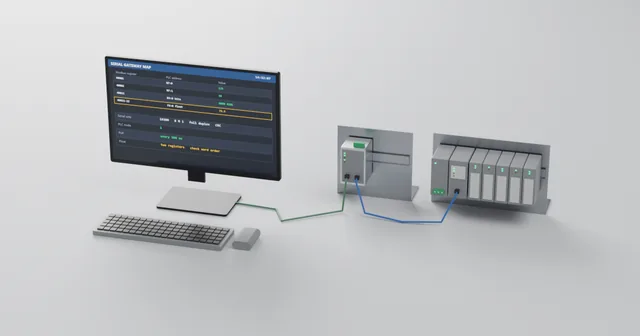
No. The SLC 5/05's built-in Ethernet port does not carry DF1 framed inside TCP the way Modbus TCP carries Modbus RTU. The port speaks PCCC controller messaging directly over TCP/IP on its native 10 Mb/s interface, and it offers no cyclic EtherNet/IP I/O service at all. That one distinction explains the confusion around this processor: data reads, writes, programming access and SCADA polls all work over the port, while an I/O originator connection to a remote Ethernet rack never establishes. The mismatch is in the service, not in the cable or the switch. This article separates what the port actually does from what people expect it to do, shows where the DF1 analogy really applies, and works the throughput arithmetic that separates the native path from a serial converter path.
What the port actually speaks #
PCCC — programmable controller communication commands — is the messaging layer shared across the legacy controller families: DF1, DH+, DH-485, and the Ethernet implementations in the SLC 5/05 and PLC-5/E. Every PCCC transaction is explicit: the request carries the operation, the source and destination identification, and the exact data-table address, and each transaction is point-to-point and unscheduled. The Ethernet channel speaks this message set over TCP/IP. DF1 is the serial transport for the same message set, so DF1 and Ethernet carry the same commands — but the 5/05's Ethernet port never frames a message as DF1. There is no serial leg anywhere in that path.
Because each message names its target and completes on its own, the model suits programming access, SCADA polling, peer-to-peer data exchange and single reads or writes. It does not build the scheduled, deterministic connection that cyclic I/O needs, and no protocol or firmware option adds that service to this processor's Ethernet port.
Where the DF1-over-Ethernet idea actually applies #
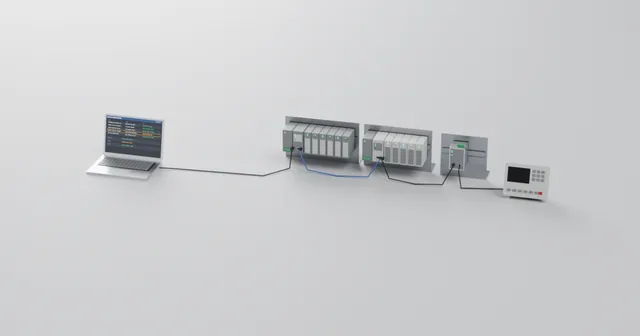
The analogy fits a different box. The 1761-NET-ENI is a serial-to-Ethernet converter: it encapsulates DF1 messages inside TCP so an Ethernet client can reach a controller that has only a serial port. That architecture really is a serial protocol wrapped in TCP, and the throughput ceiling sits on the serial side, which tops out at 19.2 kb/s on that converter. The SLC 5/05 needs none of this: its Ethernet port is native 10 Mb/s Ethernet with the PCCC message set implemented in the processor itself. If your situation is the converter path, the page on how the 1761-NET-ENI encapsulates PCCC on EtherNet/IP covers it in detail.
Explicit messaging and cyclic I/O are different CIP services #
CIP, the application layer of EtherNet/IP, defines two connection classes: explicit messaging connections and implicit, or I/O, messaging connections. Explicit messages are self-describing requests normally carried over TCP. Implicit I/O connections use a scheduled producer/consumer exchange, normally over UDP, at a fixed interval agreed when the connection opens. A cyclic I/O connection therefore needs an originator that opens and maintains it, an adapter with defined input and output assemblies, and matching connection timing and timeout behavior at both ends. The SLC 5/05 implements the explicit side only: it can message EtherNet/IP devices, but it cannot take the originator role for a remote I/O rack. The article on why explicit and implicit EtherNet/IP messaging do not interwork covers that boundary.
A practical shorthand splits EtherNet/IP work into configure, collect and control. The 5/05 covers configure and collect over Ethernet; control, in the sense of cyclic I/O ownership, is absent and stays absent.
Why a working write to B3:0 proves nothing about I/O control #
A successful MSG write to an internal bit such as B3:0 demonstrates four things: the client formed an explicit request the processor accepts, the TCP path is good, the data-table address resolves, and a response came back. It does not exercise cyclic I/O, because no scheduled connection ever opened. Cyclic I/O needs the originator/adapter relationship, defined assemblies, a producer/consumer exchange at an agreed interval, and ownership and timeout behavior on both ends — none of which a one-shot MSG transaction touches.
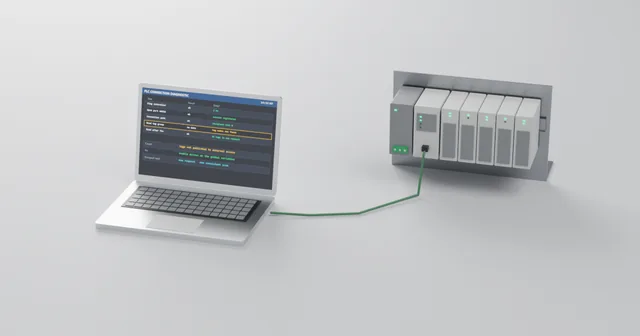
That is why the symptom is so consistent in the field: link lights on, programming and data reads good, an EtherNet/IP I/O connection to a rack that never establishes. Nothing is broken; the requested service does not exist on this port.
What the numbers show: an illustrative example #
Compare the native path with the converter path on payload time alone. Say a MSG instruction reads 10 integer words — 20 bytes of payload — from the data table. At the serial rate of 8 data bits plus start and stop per character, every byte costs 10 bits, so the payload is 200 bits. On the converter path, the serial leg runs at 19.2 kb/s at most: 200 bits ÷ 19,200 b/s = 10.4 ms, one way, for that payload alone. On the native 5/05 port at 10 Mb/s: 200 bits ÷ 10,000,000 b/s = 0.02 ms. The serial leg is 520 times slower before any framing, headers, processor service time or TCP handshaking is counted, so real transactions take longer on both paths.
The point stands: on a converter path the serial side bounds throughput, and putting faster Ethernet in front of it moves nothing. The native port has no such leg.
What to check when reads work but an I/O connection will not #
- Write down which service the application needs: explicit data access or a cyclic I/O connection. Most reports of failed communications here are really a service mismatch.
- Confirm the physical basics once — link state, IP address, subnet reachability — and stop treating the cable as suspect after they pass.
- Match the client driver to the processor: it must speak PCCC over TCP for the 5/05's Ethernet channel. The article on fixing EtherNet/IP HMI access to an older SLC 5/05 walks through that driver-side symptom.
- Test a read of a known data element before any write. A successful response exercises the application layer and proves more than a link light. For the SCADA side, the article on how a SCADA client reads a small PLC over EtherNet/IP shows the polling path.
- If a cyclic connection is the actual requirement, stop configuring: the fix is a controller platform that provides the EtherNet/IP I/O originator role.
One safety note: before any test write, confirm the machine is in a state where the target address can change safely — writing an output word that drives a live actuator moves hardware.
The decision #
- Program, monitor, poll over SCADA, or exchange data peer-to-peer with an SLC 5/05: use its Ethernet port with a PCCC-over-TCP client. It is a genuine native Ethernet connection with no serial conversion stage.
- Reach a serial-only controller from Ethernet: that is the 1761-NET-ENI's job, and its serial side sets the throughput ceiling.
- Control a remote Ethernet I/O rack cyclically: the SLC 5/05 cannot do it in any configuration. Choose a controller platform that carries the EtherNet/IP I/O originator role; no option, module or firmware change turns the 5/05 into a scanner.
Questions asked
Does the SLC 5/05 run DF1 anywhere?
Yes, on its serial channel. The built-in serial port runs DF1 for programming and peer messaging, exactly like the other SLC 500 models. The Ethernet channel is separate: it speaks PCCC over TCP/IP and never frames a message as DF1. So DF1 exists on the processor, but it lives on the serial cable, not the Ethernet cable.
What does a failed MSG instruction over this port mean?
The MSG instruction completes asynchronously and sets an error status you can branch on in logic. On the 5/05 Ethernet channel a failure usually means the target address is wrong, the destination is not a PCCC-speaking device, or the TCP path is broken. It does not mean cyclic I/O is half working, because the instruction never attempts a cyclic connection.
Which controller do I need for cyclic Ethernet I/O?
A platform that provides the EtherNet/IP I/O originator role, such as the Logix controller family. That is a platform change, not an upgrade to the SLC 5/05: no module or firmware option adds the originator function to it. Plan the change around the remote rack's assemblies and connection timing so the new originator matches what the adapter expects.
Is the Ethernet port fast enough for SCADA polling?
For data collection, yes. Each explicit transaction completes in milliseconds on the native port, so the practical poll rate is set by how many transactions you need per scan and how fast the processor services them, not by the link rate. Stagger polls across devices instead of firing every request at once, and the port rarely becomes the bottleneck.