Troubleshooting
Why an EtherCAT child bus scan shows Ecat slave in invalid state
Short answer
The scan error 0C85002A means the coupler you scan behind is below PreOP because it is not part of the master's active EtherCAT configuration. Upload the EtherCAT IO configuration to ctrlX, power-cycle the NX_ECC201 so it reinitializes and reaches OP, then retry the scan and verify by reading inputs and writing outputs.
On this page
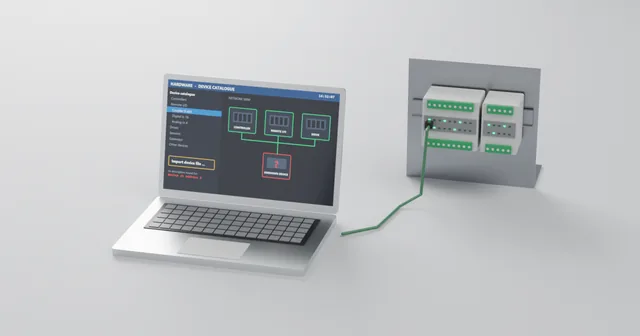
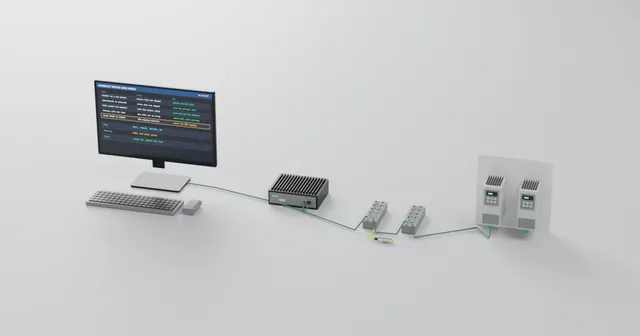
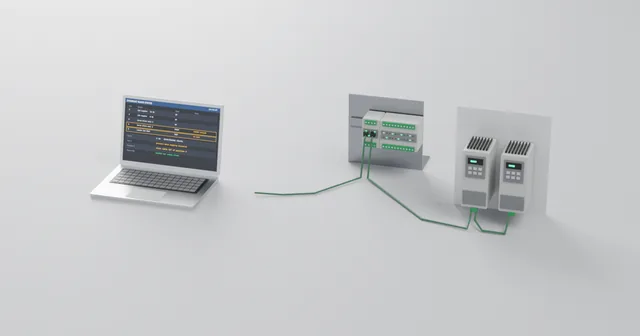
That scan error names a slave state, not a broken part. 0C85002A - Ecat Slave in invalid state appears because the coupler you are scanning behind sits at INIT or PreOP, and an EtherCAT master refuses to scan a child bus behind a slave that is not at least in PreOP. It sits there because the configuration built in the engineering view was never loaded to the master: a slave outside the master's active configuration is walked up the state ladder by no one. The fix has a fixed order. Upload the EtherCAT IO configuration to ctrlX, power-cycle the NX_ECC201 so it reinitializes against that configuration, then scan again. In the reported case the coupler rose from INIT/PreOP to OP and its input and output channels went live.
What the error text tells you #
The message has two parts: a demand and a code. The demand is the state floor: the slave has to be at least in PreOP for the scan. The code records that the scan found the slave in a state where the function cannot run.
An EtherCAT slave moves through four states: INIT, PreOP, SafeOP and OP. At INIT there is no mailbox; from PreOP the mailbox answers, and scanning the topology behind a coupler is a mailbox service, which is why PreOP is the floor. SafeOP and OP add process data exchange, and on the PreOP-to-SafeOP transition the slave checks whether the sync manager channels for process data communication are configured. A slave that clears PreOP but stalls one step later is the different fault covered in why an EtherCAT I/O slave fails the PREOP to SAFEOP transition.
Why the coupler sits below PreOP #
A master writes the state machine only of slaves it owns. The coupler had been entered by hand in the engineering view, but that configuration had not been loaded to the EtherCAT master, so in the active configuration the device did not exist and nothing commanded it out of INIT. The coupler itself was healthy: cabling, address switches and the device description were not the demonstrated cause here.
Read the error that way before touching hardware. A coupler fault, a wrong in/out port sequence, an address conflict or a wrong ESI can each hold a slave below PreOP, but they are the second wave of checks, for when the configuration sequence fails to move the state.
The sequence that fixes it #
- Enter the NX_ECC201 in the ctrlX EtherCAT configuration as the device the child bus hangs behind.
- Upload the EtherCAT IO configuration to ctrlX. A layout that exists only in the engineering view is not active on the master; the upload is the same master-side step as connecting a WAGO 750-354 EtherCAT coupler to ctrlX CORE.
- Power-cycle the NX_ECC201 after the upload, so it reinitializes against the loaded configuration.
- Watch the coupler's state run up to OP rather than stop at PreOP.
- Retry the child-bus scan.
- Verify with process data: read the input channels, then read and write an output channel. Write test outputs only with the machine in a safe state, because a live output channel can move the machine.
Do not answer this error by rescanning. Repeated scans against an unconfigured coupler return the same refusal; the state has to move first.
Worked example: an NX_ECC201 held at INIT on a ctrlX master #
Inputs, each with its source:
- The scan refusal,
0C85002A - Ecat Slave in invalid state, with the demand that the slave be at least in PreOP (the message the master returned, from the reported case). - Coupler state at the failed scan: INIT/PreOP (observed at the coupler).
- Actions taken: upload of the EtherCAT IO configuration to ctrlX, then a power cycle of the coupler (the reported fix).
- The state machine: INIT, PreOP, SafeOP, OP, three transitions in total (the EtherCAT slave state machine).
Rule, in words: the master walks a configured slave up the ladder one transition at a time, and the child-bus scan is a mailbox service that needs at least the first transition, INIT to PreOP, complete.
Arithmetic:
- Transitions the scan requires: at least 1 of 3.
- Transitions completed at the failed scan: 0 of 3, because the coupler sat at INIT.
- Shortfall: 1 required minus 0 completed = 1 transition, so the scan was refused.
- After the upload and the power cycle: 3 of 3 (INIT to PreOP to SafeOP to OP), which is 2 transitions above the scan minimum.
Result: the rescan succeeded; the input channels could be read and the output channels read and written.
Decision: at 1 transition or more (PreOP or above) the scan runs, and at 3 of 3 (OP) cyclic process data is live, which is where the example coupler ended up. If the coupler still shows 0 transitions (INIT) after its power cycle, stop scanning and run the checks below.
Checks when the coupler stays below PreOP #
Run these in order, once the upload-and-power-cycle sequence has been done:
- Read the coupler's LEDs first; they separate no link, a bus error and a state problem.
- Confirm the EtherCAT cable uses the coupler's in and out ports in the intended sequence.
- Compare the coupler's address switches with the addresses of the other devices on the network.
- Confirm the ESI matches the coupler and note the installed CtrlX Ecat/IO Engineering version, so the device description and the engineering tool agree.
- Pull the ctrlX I/O slices temporarily and scan with the coupler as the first or only device; if the state then rises, another device or the topology was holding startup down.
Questions asked
Does the coupler need to be in OP before I scan the child bus?
No. The scan needs only PreOP, the state in which the slave's mailbox answers. SafeOP and OP add process data exchange, which the scan itself does not use. You confirm OP anyway because the upload-and-restart sequence that makes the scan work carries the coupler all the way there, and cyclic I/O needs OP.
The coupler reached OP once but drops back after a later restart. What changed?
Most likely the active configuration. If the project was reloaded from the engineering view without the coupler in it, the master again owns no entry for the device and nothing walks it up the ladder. Re-upload the configuration that contains the coupler, power-cycle it, and confirm it returns to OP after a cold start before trusting the installation.
Is a successful child-bus scan proof that the I/O channels work?
No. A completed scan proves the master reached the mailbox behind the coupler, not that the channel mapping or the field wiring is right. Read the input channels against the connected field devices and write an output channel to see it respond. Only when observed values and output behavior match the project mapping is the coupler verified.
Can an AL status code on the coupler explain a refused state change?
Yes. When a requested change of state cannot be executed, or the slave detects an internal error, it reports an AL status code that names the reason. Read that code before changing wiring: it tells you whether a transition was refused, for example by a missing process data setup, or whether the device itself flagged a fault.