Explainer
PROFINET and Modbus on the same device: why one primary fieldbus
Short answer
A device such as a robot can run PROFINET and Modbus over the same Ethernet interface, because every Modbus connection is established independently of the fieldbus stack. The restriction is on the primary controlling fieldbus: you choose PROFINET or EtherNet/IP, not both, and only one PLC may command the device at a time.
On this page
Yes: a device can run PROFINET and Modbus over the same Ethernet interface at the same time. The Modbus connections do not compete with PROFINET, because each one is established independently and does not depend on the device's fieldbus selection. What you cannot do is run two primary controlling fieldbuses, PROFINET and EtherNet/IP, at once, or have two PLCs commanding the same device simultaneously. Choose one primary fieldbus, keep Modbus independent, and give control to one PLC. The same coexistence holds at the PLC port, as covered in why Modbus TCP and PROFINET I/O can share one interface; this article is about the device side: which fieldbus the device treats as primary and who owns control.
The distinction: sharing a link versus sharing control #
Two different things are being shared, and only one of them is unrestricted. The Ethernet interface, cable and switches are shared freely: several protocol stacks can push traffic through one physical port, and the sessions, connection state and data mappings stay separate. Control ownership is not shared: a device accepts one controlling fieldbus and one commanding controller.
The combination table below is the decision grid for a device that offers PROFINET, EtherNet/IP and Modbus on one Ethernet interface:
| Combination | Connection model | Constraint | Decision |
|---|---|---|---|
| PROFINET + Modbus | Independent connections on one interface | Assign control to the PROFINET path | Supported; use it |
| EtherNet/IP + Modbus | Independent connections on one interface | Assign control to the EtherNet/IP path | Supported alternative |
| PROFINET + EtherNet/IP | Two competing primary fieldbus modes | Mutually exclusive on the device | Choose one, not both |
| Two PLCs commanding the device | Two command owners | Concurrent control is not supported | One PLC is the control owner |
| Several Modbus peers | Each connection independent | Keep addressing and data ownership distinct | Supported; common in the field |
The mutual exclusion is a property of the device's fieldbus configuration: PROFINET and EtherNet/IP are presented as alternative primary modes, and selecting one disables the other. Modbus sits outside that selection entirely, which is why "choose one" never means "turn Modbus off." For the protocol-level differences behind this, see why PROFINET, PROFIBUS and Modbus are four separate protocols.
How the two paths stay separate on one cable #
Follow a packet in each direction. A PROFINET controller sends its cyclic exchange through its port, across the cable and switch path, into the device's PROFINET stack, where it lands in the mapped process I/O. A Modbus client's request takes the same physical hops but terminates in the device's independent Modbus service and its own register map. Sharing the interface merges nothing above layer one: not the sessions, not the connection state, not the command authority.
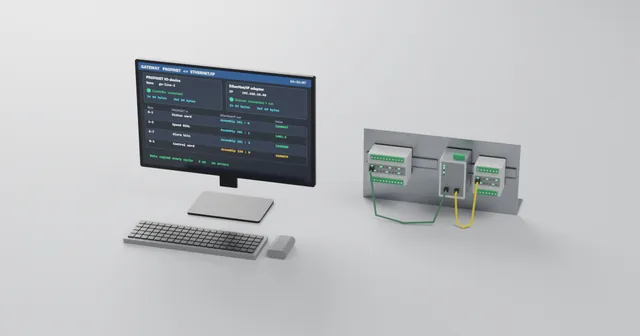
Two practical consequences follow. First, the two paths share their failure domain at the bottom: a dead cable, bad switch port or duplicate IP address takes down both protocols together. Second, each path carries its own configuration. The PROFINET side takes its identity, I/O layout and update time from the controller's engineering configuration; the Modbus side keeps the address, port and register mapping it already had. Never copy a setting from one stack to the other just because they share a port. If the Modbus side is serial rather than TCP, a PROFINET to Modbus gateway bridges the two, with dual Ethernet ports that can also pass data between PROFINET and Modbus TCP devices on different subnets.
Worked example: a robot with Modbus configured, adding PROFINET #
This is the concrete case an engineer faces: Modbus is already configured and running on the robot's Ethernet interface, and the question is whether PROFINET can be enabled through the same connection.
The inputs, all from the device's architecture described above:
- Primary fieldbus modes offered: PROFINET and EtherNet/IP, mutually exclusive, so the permitted count of active primary fieldbus modes is 1.
- Existing Modbus connections: independent of the fieldbus selection, permitted count set only by the device's documented connection limit.
- Command writers allowed for motion, start, mode and reset: 1.
The rule in words: active primary fieldbus modes must not exceed 1, and writers of command-bearing data must not exceed 1.
The arithmetic for the proposed configuration:
- Primary fieldbus modes: PROFINET (1) + EtherNet/IP (0) = 1, which equals the limit of 1. Pass.
- Command writers: PLC over PROFINET (1) + Modbus peers writing commands (0) = 1, which equals the limit of 1. Pass.
The result: the configuration is valid. PROFINET is selected as the primary fieldbus, EtherNet/IP stays inactive, Modbus keeps its existing connections, and the Modbus side is restricted to supervisory data, status consumption and a separately defined interface that writes no motion commands.
The decision: enable PROFINET on the shared interface and leave the working Modbus configuration untouched. Above one command writer (for example, if a Modbus client must also start the robot), remove or arbitrate the extra writer in the application before enabling either path.
Where coexistence stops, and how to localize it #
When both protocols run and something fails, the failure pattern tells you where to look. Both protocols dead points at the shared physical path: link indication, cable, switch port, or an address collision. One protocol dead with the other healthy means the shared path is passing traffic, so the fault sits in the failing protocol's own configuration, connection state or mapping.
| Symptom | Likely stopping point | Next check |
|---|---|---|
| Neither protocol exchanges data | Physical link or shared network path | Link indication, cable, switch port, address reachability |
| Modbus works, PROFINET does not start | Fieldbus selection or controller relationship | Confirm PROFINET, not EtherNet/IP, is selected; compare controller and device configuration |
| PROFINET works, Modbus stops | Independent Modbus session or mapping | Its initiator, destination address, connection state, requested data range |
| Both connect but commands conflict | Application ownership | Remove duplicate command writers; keep one PLC as control owner |
| Intermittent once both run | Traffic rate, connection churn, network quality | Capture interface counters and traffic; compare faults with polling and update activity |
A reachability test proves only that the device answers its address; it does not prove the cyclic I/O or the Modbus data is valid. Confirm each path through its own connection status and live values.
The architecture to commit to #
Use one PLC over PROFINET as the control owner, with Modbus independent beside it. If the installed primary fieldbus is already EtherNet/IP, keep it and add Modbus independently; switching the primary fieldbus changes the controller relationship and the process-data mapping, and is never required just to add Modbus. Where two systems need the same status, let both read it. Where two systems could write commands, define arbitration in the application or delete one writer: network coexistence cannot resolve contradictory commands, and no configuration on the shared interface will make two owners safe.
Questions asked
Can I add EtherNet/IP to the same device that already runs PROFINET and Modbus?
No, not as a control fieldbus. The device configuration presents PROFINET and EtherNet/IP as mutually exclusive primary modes, so activating EtherNet/IP means giving up PROFINET, not adding to it. Modbus stays because it is not a primary fieldbus mode at all; it is a set of independent connections. If a second controller speaks EtherNet/IP, put a gateway between it and the PROFINET side instead of changing the device's mode.
How many Modbus connections can run beside the fieldbus?
The limit is set by the device's documented connection and server-resource count, not by the presence of PROFINET. Installations with several Modbus devices exchanging with one machine are common and run without issue. Count the connections the device supports in its manual, subtract the ones already in use, and keep each connection's addressing and data ownership distinct so two clients never write the same register.
Does a successful ping prove the PROFINET and Modbus paths are both healthy?
No. A ping proves only that the device's IP address answers on the network path. The PROFINET controller relationship, the cyclic I/O mapping, and each Modbus session and its data range can all still be down or misconfigured while the ping succeeds. Verify each protocol through its own connection status and live data, not through reachability alone.