InnovationResearchScience

Scientists Design First Liquid Relaxor Ferroelectrics Through Molecular Engineering

Researchers have conceived a new class of liquid relaxor ferroelectrics by strategically introducing polarity heterogeneity. The breakthrough enables enhanced dielectric responses previously unattainable in liquid matter systems.

Revolutionary Approach to Liquid Ferroelectrics

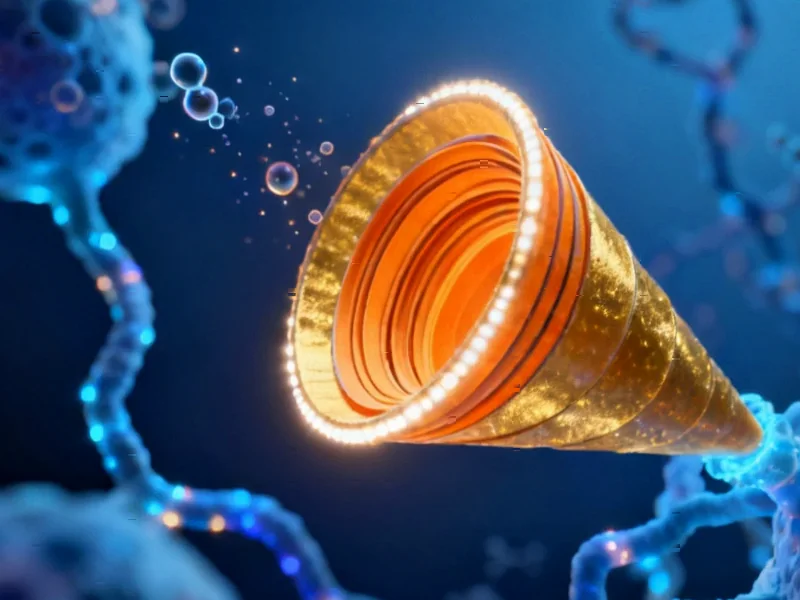
Scientists have reportedly designed the first liquid-matter relaxor ferroelectrics (nRFE) through direct molecular engineering, according to research published in Nature Communications. Unlike conventional solid-state relaxor ferroelectrics that rely on chemical doping in crystalline lattices, this novel approach introduces polarity heterogeneity by dispersing polar nanoregions (nPNRs) within apolar nematic liquid crystal backgrounds. Sources indicate this represents a paradigm shift in ferroelectric material design, enabling unprecedented dielectric properties in fluid systems.


ResearchScienceTechnology

Breakthrough Cryo-EM Strategy Enables High-Resolution Imaging of Small Cancer Proteins

Scientists have overcome a major limitation in cryo-electron microscopy by developing a novel fusion strategy that enables high-resolution structural determination of small proteins. The breakthrough method successfully resolved the structure of cancer-related kRasG12C at 3.7 Å resolution, clearly showing how inhibitor drug MRTX849 interacts with its target.

Overcoming Size Limitations in Structural Biology

Structural biologists have reportedly developed an innovative approach that extends the capabilities of cryo-electron microscopy to small protein targets previously considered too challenging for high-resolution analysis, according to recent research published in Scientific Reports. The new method addresses what sources indicate has been a fundamental limitation in the field—the difficulty of imaging proteins smaller than 50 kilodaltons (kDa) using single-particle cryo-EM techniques.

HealthcareResearchScience

Multi-Omics Study Reveals Immune Cell Genes Linked to Parkinson’s Disease, Highlights Drug Repurposing Candidates

A comprehensive multi-omics study has uncovered specific immune cell genes that contribute to Parkinson’s disease susceptibility. The research identifies multiple drug candidates with potential for repurposing, including existing medications that could target these genetic pathways.

Immune Cell Genetics Reveal Parkinson’s Disease Mechanisms

Researchers have identified 28 immune cell-specific genes that significantly influence Parkinson’s disease risk through a sophisticated multi-omics approach, according to a recent study published in npj Parkinson’s Disease. The investigation, which combined genetic analysis with drug database screening, reportedly reveals novel mechanisms by which peripheral immune cells contribute to PD pathogenesis and identifies several promising drug repurposing candidates.

HealthcareInnovationScience

Breakthrough Diagnostic Tools Emerge for Endometriosis Detection

Revolutionary noninvasive tests are transforming endometriosis diagnosis, using saliva samples and cutting-edge biomarker technology. These developments promise to shorten diagnostic delays and enable more targeted treatment approaches for the chronic condition.

New Era in Endometriosis Diagnosis

Advanced noninvasive testing methods are emerging that could significantly reduce the diagnostic timeline for endometriosis, according to recent reports. These developments come as multiple countries launch major initiatives to address what has historically been a challenging condition to diagnose, often requiring invasive surgical procedures for confirmation.

PhysicsResearchScience

Research Reveals Common Mechanism in Phonon Thermal Hall Effects Across Magnetic and Non-Magnetic Materials

A new study comparing magnetic and non-magnetic materials reveals that phonon thermal Hall effects share a common origin in extrinsic impurity scattering. The findings could help distinguish between competing mechanisms in thermal transport research.

Breakthrough in Understanding Phonon Thermal Hall Effects

Researchers have made significant progress in understanding the mysterious thermal Hall effects observed in insulating materials, according to a recent study published in Scientific Reports. The research team investigated the field-angle dependence of thermal Hall conductivity in both magnetic and non-magnetic compounds, revealing what analysts suggest is a common mechanism driven by extrinsic impurity-induced scatterings.