Explainer
Why an Omron NJ cannot read an SLC 5/04 as a CIP device
Short answer
The SLC 5/04 has no Ethernet port and no CIP stack, so no controller can read it as a CIP device: it answers PCCC on DH+ only. An Omron NJ or NX can read it directly only when its CIP message instruction sends a hand-built Execute PCCC request (service 0x4B) to the DH+ gateway, with the DH+ node and data-table address inside the payload. If the instruction cannot carry that raw payload, keep the ControlLogix MSG as the intermediary and read its Logix tags instead.
On this page
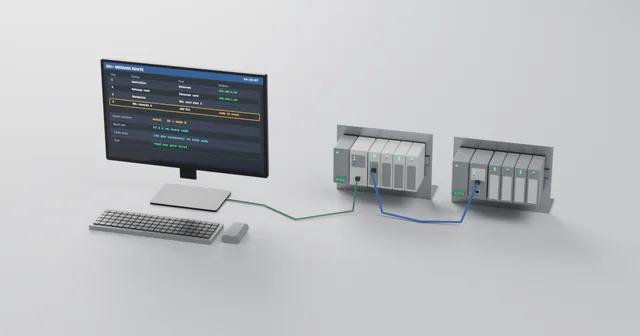
The SLC 5/04 cannot be read as a CIP device: it has no Ethernet port and no CIP object stack, and the only read/write protocol it answers is PCCC, on its DH+ channel or its serial DF1 channel. Every host that reaches its data table over Ethernet — a ControlLogix MSG, RSLinx Classic with PCCC encapsulation, an HMI's Allen-Bradley Ethernet driver through an EQ7000 bridge — sends CIP to the gateway and stops there, using the Execute PCCC service 0x4B with the DH+ node and data-table address packed inside the payload. An Omron NJ or NX can do the same, and one thing decides it: whether its CIP message instruction accepts a service code and payload you build by hand.
Why no CIP request reaches the SLC 5/04 #
The 5/04 gives you two doors into its data table: the DH+ channel and an RS-232 channel running DF1. Both carry PCCC. There is no EtherNet/IP port and no CIP object model on the processor, so there is no class, instance or service to address on the SLC itself; a CIP Read Tag aimed at it has nothing to answer.
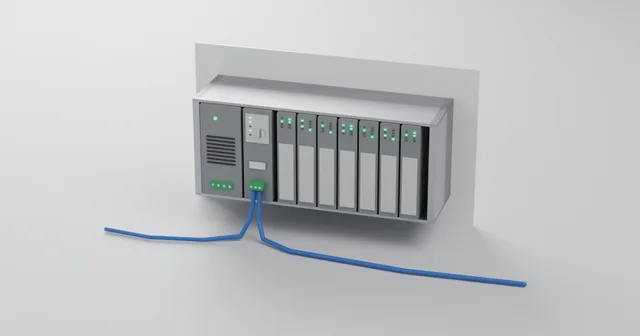
The CIP end of the exchange belongs to the gateway. In a ControlLogix bridge, the 1756-DHRIO (and the 1756-DHRIOXT) executes the PCCC commands documented in its user manual's appendix when it receives them, and the 1756-ENET module carries CIP over Ethernet into that chassis — the mechanism behind RSLinx Classic's PCCC-encapsulation option. The EQ7000 does the same job in one box: it accepts the message on its Ethernet port and runs the DH+ transaction itself.
The request chain is therefore fixed: your controller, Ethernet to the gateway, DH+ to the node, PCCC in both directions on that last hop. Nothing you configure on the Omron side changes where the SLC's protocol starts.
What every working read has in common #
Strip off the software and every working message is the same message: a UCMM request — the unconnected explicit-message service — addressed to the gateway, service 0x4B, Execute PCCC, on the PCCC object (class 0x67, instance 1) that the CIP specification defines for exactly this encapsulation. The payload is a complete PCCC command: function, destination DH+ node, data-table file and element, element count. The PCCC reply rides back inside the same CIP transaction.
The Logix MSG instruction hides all of that behind a dialog: check boxes and pull-downs fill the payload for you, and the CompactLogix MSG path to an SLC 5/04 through a DH+ gateway shows the route that dialog assembles. An HMI driver hides it the same way. Built by hand, every field those dialogs fill becomes a byte you supply yourself.
You do not derive those bytes from the specification. The DHRIO manual appendix documents the PCCC commands the module executes, and the bridge vendor documents the exact UCMM layout for this hardware in EQ7000 DH+ bridge UCMM message format for an SLC 5/04. Build the first message by copying one documented example field for field; do not improvise the field order.
The one instruction capability that decides it #
The NJ/NX-series Instructions Reference Manual (W502) describes an instruction that sends a UCMM CIP message to a specified device on a CIP network — the right shape of tool. What you must confirm on your controller and version is how much of the message it exposes:
- you can enter the service code yourself (75 if the instruction wants decimal);
- you can set the object class and instance;
- the request payload is an array you fill byte by byte;
- the response returns raw bytes with a status you can inspect.
All four true: the direct read is possible, and the rest of this article is how to build it. If the instruction offers only named services or tag-style addressing, it cannot emit Execute PCCC, and generic EtherNet/IP connectivity proves nothing — a clean Read Tag exchange with a Logix CPU is a different message entirely.
Worked example: node 37 octal, ten words #
Example values throughout — replace each with yours. Say the SLC 5/04 shows DH+ node 37, you want integer file N7 from element 0 for 10 words, and the instruction call gives a 32-byte response area.
Node first. DH+ node numbers are octal, so 37 means 3×8 + 7 = 31 decimal, and the byte in the payload is 0x1F. Keying 37 decimal (0x25) instead is the classic silent failure: the gateway polls a node that does not exist and returns a PCCC status you will misread as an address problem.
Size next. Ten integer words are 10 × 2 = 20 data bytes, which fits the 32-byte response area with room for the reply header. A 100-word block is 200 bytes and does not fit; split it into chunks the area holds and trigger them in sequence.
Then settle byte order once. Put 258 decimal (0x0102) into N7:0 from the SLC programming software and trigger the read: low byte first means the words drop straight into an INT array, which the Omron controller also stores low byte first; high byte first means you swap each pair before use.
Where a failed request stops #
- No CIP reply, or a timeout: the request never reached a CIP endpoint. Fix the gateway address and the route to it before touching the payload.
- A CIP status error in the reply: an endpoint answered but rejected the service, class or instance — you reached the Logix CPU or a comms module instead of the PCCC object fronting the DH+ side.
- CIP success with a nonzero PCCC status inside the payload: the message crossed Ethernet and executed on the DH+ side but failed there. Check the octal-to-decimal node conversion, that the file exists in that processor's data table, and the element count.
- Good status, wrong value: address offset or byte order. Rerun the 258 test word before changing anything else.
The names and encodings of the status fields depend on your instruction and gateway; take them from their documentation, not from an example.
The decision for each setup #
EQ7000 in place and the instruction exposes the payload: commit to the direct read. Build the message field for field from the bridge's documented format, trigger it at the poll rate you need — UCMM leaves no connection to manage — and retire the ControlLogix MSG from the data path.
1756-DHRIO in a ControlLogix and the instruction exposes the payload: same commitment, one extra field. Address the request to the gateway route the MSG already uses, and a bridge chassis with no CPU still works, because the DHRIO executes the PCCC it receives.
Instruction cannot carry a raw service and payload: stop there — no function-block substitution turns it into a CIP client for this message. Keep the ControlLogix MSG copying SLC data into Logix tags and read those tags from the Omron side; reading Logix tags from CODESYS with a generic CIP service is the same discipline that works for any third-party controller. Or take reaching PLC-5 and SLC 500 data through a ControlLogix DH+ bridge as the OPC UA route and drop the tag copying altogether.
When you move to writes, make the first one to a spare integer element no running logic reads, read it back, and only then touch a file the program uses — a wrong offset on a write is a process change, not a communications error.
Questions asked
Does the SLC 5/05 answer CIP reads directly since it has an Ethernet port?
No. The 5/05 puts PCCC on its Ethernet port rather than the Logix tag database a CIP Read Tag expects, so hosts reach it with the same Execute PCCC encapsulation, just without a separate bridge. A new build that needs native CIP objects should not use an SLC at all; a CompactLogix serves its tags directly. For the installed 5/04, the gateway message described here is the only Ethernet path.
Can the 1756-DHRIO map SLC data-table files into Logix tags so the Omron controller reads normal tags?
Not by itself. The DHRIO executes the PCCC it receives and bridges to DH+; it does not publish SLC files as CIP tag objects. To get tags, a Logix processor in the chassis must run MSG instructions that copy SLC data into its own tag database, which is exactly the intermediary setup the direct read is meant to replace. With a bridge chassis that has no CPU, the PCCC route is the only route.
How many stations can share one DH+ link, and why does the node number break payloads?
Up to 64 stations share one DH+ link, addressed 00 to 77 octal, and that octal display is the trap: the payload byte is binary, so 77 octal is 63 decimal, the last valid node. Convert before keying the payload, and confirm no other station holds the same number, because a duplicate node shows up as intermittent read failures rather than a configuration error.
Is UCMM fast enough to poll the SLC every scan?
Trigger the instruction per poll, not per scan. Each UCMM transaction carries connection overhead, and the DH+ hop is the slow part of the chain, so one message reading a block of words beats many single-word messages at any rate. For typical monitoring, read the whole block you need once or twice per second and buffer it in the Omron controller; its logic then runs on local data with no dependence on DH+ timing.