Explainer
Reading Allen-Bradley PLC data without RSLinx running
Short answer
An Ethernet connection to an Allen-Bradley controller carries no PLC data by itself. Your application needs a component that implements the controller's data-access services on top of EtherNet/IP: a polling client for request-driven reads, an OPC server or listener for controller-initiated messages, or an adapter stack for cyclic I/O connections. Prove the path with one explicit scalar read while RSLinx is closed.
On this page
When RSLinx is gone and the custom application shows no PLC data, the Ethernet cable is usually not the fault. EtherNet/IP is the transport; it carries no Logix data until some component on your computer implements the data-access services the controller speaks. Replace RSLinx with the component that matches your traffic model, then prove the path with one explicit scalar read while RSLinx is closed.
Why an open socket is not data access #
EtherNet/IP gives you the network transport and the encapsulation frame. On top of that sits the CIP object model and, for Logix controllers, the data-access behavior Rockwell documents in publication 1756-PM020. A TCP session to the controller's port 44818 proves the transport; it proves nothing about your application's ability to build a tag request, decode a reply or handle a protocol error.
This is why "we have Ethernet/IP and it works with RSLinx" is only half a test. RSLinx brings its own driver and data-access layer, so its success tells you the cable, switch, IP route and controller are healthy. It tells you nothing about whether your replacement implements the same services. The replacement must be tested on its own, with RSLinx stopped.
Three traffic models, three initiator roles #
Every working replacement fits one of three models. The models differ in who starts the exchange, and picking the wrong one is the most common reason a project stalls.
- Polling (client-initiated). Your computer opens a session, requests a tag, waits for the reply and repeats at your rate. The controller is a CIP data server; the application is the client. This is the shortest development path for reading selected values.
- Unsolicited (controller-initiated). Controller logic produces the data and sends it to a configured destination. Your computer must expose a listener at that destination and consume the transfer. Unsolicited does not mean an ordinary client receives values automatically: the controller needs a supported production mechanism and a destination, and the receiver must stay available there.
- I/O-style (cyclic connection). Your computer behaves like an EtherNet/IP adapter in a cyclic connection, typically on UDP port 2222. This needs an adapter stack such as OpENer and matching connection parameters and data layouts on both ends. It is a different architecture from periodically reading tags, not a faster version of it.
If your requirement is only "read some values periodically," choose polling. Do not choose unsolicited merely to avoid polling; choose it only when the controller must initiate and both endpoints implement the same method.
Choose the smallest workable component #
For polling, use a client library that implements the Logix tag addressing model for your controller family. The Python project pylogix is one identified option for simple EtherNet/IP reads of Allen-Bradley controllers; confirm its controller-family coverage and required operations before adopting it.
For controller-initiated delivery, use an OPC server or packaged product with that documented capability for your exact controller family. "Allen-Bradley support" is not enough: confirm the specific driver, message direction and licensing, because an unsolicited method supported on one family may be absent on another.
For cyclic I/O participation, use an adapter stack such as OpENer and treat the computer as an I/O device on the network. If you end up considering explicit messaging from an IEC environment, the CODESYS EtherNet/IP Services library is one identified route, and the same layered test below applies.
Write your own EtherNet/IP stack only when none of the above can meet the requirement. Stack development adds session management, encoding, routing, connection state, timeout recovery and protocol-status handling to the application scope, and it moves the whole data-access burden into code you must validate.
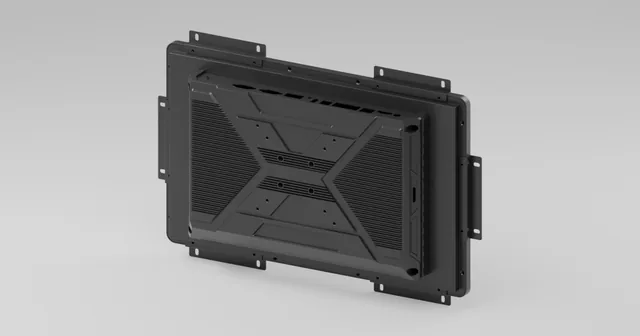
When the replacement is a Windows application or service that must sit at the machine and run this data path continuously, the host itself becomes plant equipment; at that point an industrial panel PC in the cabinet door is the appropriate host rather than an office desktop.
Configure the replacement in order #
- Identify the controller family. "Any Allen-Bradley PLC" is not a usable requirement. Record the exact family, firmware and the addressing model already proven through RSLinx.
- Define the data contract. List every value: its tag, native data type, array length, access direction and required update behavior. Decide how stale data is detected.
- Select the traffic model — polling, unsolicited or cyclic I/O — against the roles above.
- Carry the working route. Copy the controller address and any routing information from the proven RSLinx configuration into the replacement. Check publication 1756-PM020 for the data-access method you are implementing, and the chosen stack's documentation for its parameters.
- Prove one scalar transfer before adding arrays, structures, writes or scheduling.
- Add failure handling. Log connection state, protocol status, requested item and timestamp. Flag or reject stale values after communication loss instead of presenting them as current.
- Expand incrementally, one data type or transfer group at a time, repeating fault and recovery tests.
The acceptance test: one read, RSLinx closed #
Run the whole test with RSLinx stopped, and confirm independence from your application's own logs, not from a parallel RSLinx browse.
- Open an EtherNet/IP session from the replacement to the controller. Expect the session setup to succeed against the controller address carried from step 4.
- Read one known tag. For example, read a DINT tag
Test_Valuethat the controller holds at 12345. The application must return 12345 as a DINT, not as a string or reversed byte order — a wrong value with a successful status means the decoding layer is at fault, not the network. - Change
Test_Valuein the controller to 67890 and confirm the application receives 67890. This proves the read returns live data, not a cached copy. Arithmetic check: if your polling interval is 250 ms and the value changes every cycle, 4 s of running should deliver about 4 s ÷ 0.25 s = 16 updates; significantly fewer means the actual interval is longer than the configured one. - For polling, measure the real update interval at your expected item count and confirm reads return success rather than cached data.
- For unsolicited, configure one controller-originated transfer to your listener, confirm each arrival is recorded, and restart the receiver to confirm the transfer recovers rather than stalls permanently.
- Disconnect and restore the network. Verify fault indication, stale-data flagging, reconnection and resumed updates.
- Restart the application and then the controller communications separately, confirming recovery in both sequences.
Only after this test passes should controller logic be touched, if it must be touched at all — polling usually requires none.
Reading further #
The step-by-step of getting a laptop to exchange data with a CompactLogix controller without RSLinx is covered in article:how-a-laptop-reads-compactlogix-data-without-rslinx, and the mechanics of a single explicit message exchange are in article:read-ethernet-ip-module-register-data-with-explicit-messaging. For the SCADA side, where a server component normally owns the controller connection, article:where-an-opc-ua-server-sits-when-python-reads-plc-data explains the placement options. If the data path ends at a workstation that only monitors or alarms, article:getting-compactlogix-plc-data-into-excel-over-ethernet-ip shows the spreadsheet route.
Decision. Read selected values on your schedule: use a polling client library. The controller must initiate delivery: use a product with documented unsolicited support for your exact controller family, plus a listener you keep running. The computer must be an I/O device: use an adapter stack such as OpENer. In every case, accept the replacement only after one explicit scalar read passes with RSLinx closed.
Questions asked
Can I talk to an Allen-Bradley PLC over plain TCP sockets without any library?
No. The controller expects CIP services wrapped in EtherNet/IP encapsulation on TCP port 44818 for explicit messaging. A raw socket gets you to the port, but every request still needs the session handshake, encapsulation header, CIP service code and the Logix tag addressing scheme. Use a client library that implements the Rockwell data-access behavior, and verify it against publication 1756-PM020.
Does unsolicited messaging mean my client receives values automatically?
No. Unsolicited means the controller initiates the transfer, not that any listener receives it. The controller must be configured with a destination, the receiving computer must expose a compatible listener at that destination, and the listener must understand the service used. An ordinary polling client that only opens sessions and reads tags will never see controller-initiated messages.
What is the fastest way to test a replacement before writing much code?
Read one known tag with a simple polling client such as pylogix while RSLinx is closed, then change that tag value in the controller and confirm the new value and data type arrive at your application. This proves session setup, routing, tag addressing and decoding in one test before you add arrays, structures or writes.
Why does my application connect but every read fails?
The transport is working, so the fault is above it. Check the tag name against the controller's actual tag scope, the data type and array bounds, the CIP service the library sends, and the status code in the reply. A session open only proves the encapsulation layer; a failed read usually points at addressing or a service the target controller family does not support.
Is writing my own EtherNet/IP stack a reasonable option?
Only when no supported client, OPC server or adapter stack can meet the requirement. A full stack adds session management, encapsulation, encoding, routing, connection state machines, timeout recovery and protocol-status handling to your scope. For polling reads, an existing client library is normally the shortest defensible path.