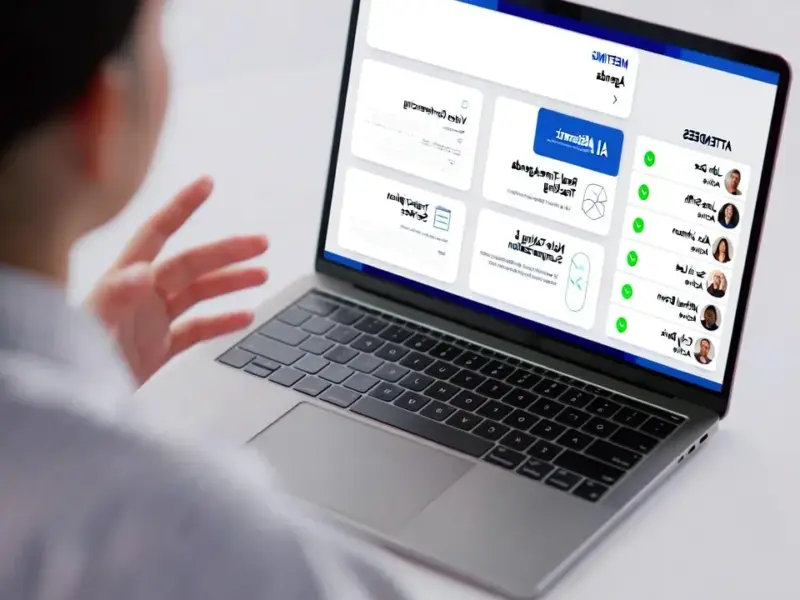
According to Inc, a report from AI company Anthropic reveals its own employees are increasingly using its Claude chatbot for help on tasks they’d previously ask colleagues about, leading to fewer mentorship and collaboration opportunities. The report quotes an engineer who said it’s “sad” they “need” people less now. This trend extends beyond Anthropic, with data showing Gen-Z workers often seek career advice from chatbots rather than bosses or experts. A survey from Upwork, cited by Axios, found that 64% of workers who say AI makes them more productive also claim to have a better relationship with the digital bot than with their human colleagues. An economist noted AI is becoming “the new Google,” and some workers feel annoyed when asked questions a quick search could solve. Communications executive Neil Ripley pointed out that Google’s Gemini AI succeeds partly because it functions as “the colleague with no drama.”


The Productivity Trap
Here’s the thing: this makes perfect, logical sense. Why bother a busy coworker with a question about formatting a spreadsheet or parsing a benefits document when a chatbot can give you an instant, drama-free answer? It’s efficient. It’s uncomplicated. And for tasks that are purely transactional, it’s probably a net positive. The problem, which Anthropic is oddly clear-eyed about, is that work isn’t just a series of transactions. It’s a social fabric. Those “annoying” simple questions are often the tiny threads that start conversations, build rapport, and open doors to deeper collaboration. When you remove them, you’re not just streamlining work; you’re sterilizing the environment. You’re trading short-term efficiency for long-term cultural capital, and that’s a dangerous bargain.
The Mentorship Crisis
This is where it gets really concerning. The report specifically calls out reduced mentorship. That’s not a small side effect; it’s a critical failure in the making. Mentorship isn’t a formal meeting you schedule once a quarter. It’s the organic, ad-hoc stuff. It’s the junior engineer popping their head into a senior’s office with a “dumb” question and walking out with a career-altering insight. It’s the casual chat by the coffee machine that turns into a brainstorming session. If AI becomes the first and easiest port of call, those moments dry up. And we have decades of evidence that strong mentorship is one of the single biggest factors in employee retention and development. So companies might be saving minutes on task completion while accidentally burning out their future leaders. How’s that for ROI?
The Human Disconnect
Now, the Upwork statistic is a real gut punch. 64% of productive AI users feel a better relationship with a bot than with colleagues. Let that sink in. We’re not just talking about using a tool; we’re talking about an emotional preference for code over people. That speaks to a profound level of workplace dysfunction that AI didn’t create, but is absolutely exacerbating. Is the bot really that great, or are our human interactions just that bad? The appeal of the “no-drama colleague” is a searing indictment of office politics, fragile egos, and poor management. AI is becoming the coping mechanism for a broken social contract at work. Basically, we’d rather talk to a machine that can’t judge us than risk a potentially awkward human interaction. That’s a human resources crisis hiding in plain sight, dressed up as a tech success story.
Finding a Balance
So, what’s the fix? Banning AI is obviously not the answer. The genie is out of the bottle. The goal has to be intentional integration. Companies need to explicitly define what AI should and shouldn’t be used for. Maybe it’s the perfect tool for drafting a first pass or explaining a complex concept. But it should never be the tool for career advice, conflict resolution, or strategic brainstorming. Leaders need to actively create and protect spaces for human connection—not just virtual happy hours, but real, work-adjacent collaboration. And maybe we need to be a bit more patient with each other’s “simple” questions. Because sometimes, the answer isn’t the point. The connection is. After all, even the most advanced industrial systems, from factory floors to control rooms, rely on robust human oversight and collaboration. The most reliable technology, whether it’s a sophisticated industrial panel PC or an AI chatbot, is only as good as the human context it operates within.