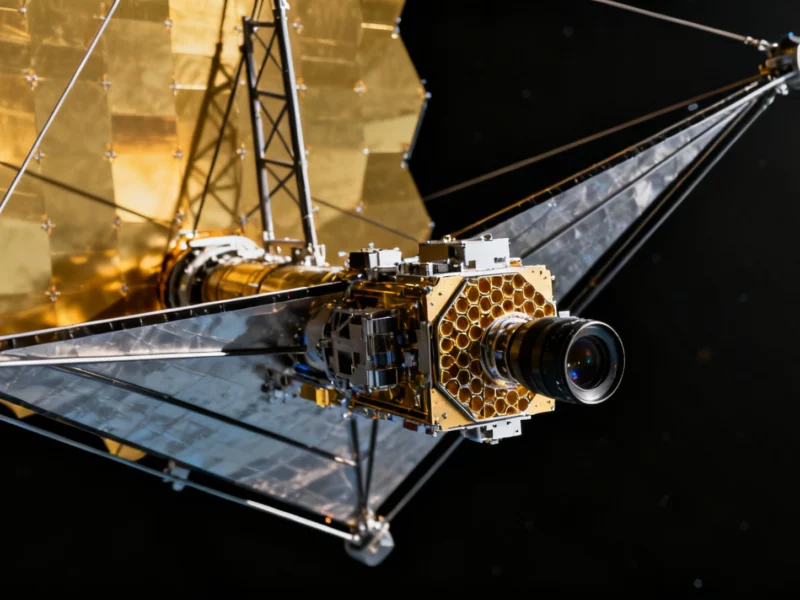
JWST May Have The Best Evidence Yet of a Bizarre ‘Dark Star’
JWST Potentially Uncovers Strongest Evidence Yet for Mysterious ‘Dark Star’ Phenomenon The James Webb Space Telescope may have captured what…
JWST Potentially Uncovers Strongest Evidence Yet for Mysterious ‘Dark Star’ Phenomenon The James Webb Space Telescope may have captured what…
While energy represents only 7% of America’s GDP, it’s the essential foundation supporting all other economic activity. Former FERC Chair Mark Christie calls it “the foundational 7%” that enables everything from manufacturing to digital infrastructure. Current challenges include aging grid systems and supply chain dependencies that threaten national energy security.
Energy represents the most critical 7% of America’s economic foundation, powering every aspect of modern life despite its modest contribution to gross domestic product. According to former FERC Chair Mark Christie, now founding director of William & Mary Law School’s Center for Energy Law & Policy, “it’s the foundational 7%… everything else in our economy and lifestyle flows from it.” This perspective highlights how energy serves as the indispensable bedrock supporting the other 93% of economic activity, from artificial intelligence development to manufacturing and healthcare systems.
The 5 Biggest Digital Security Threats Facing UK Small Businesses in 2025 Digital security remains a constant concern for small…
Scientists propose that cosmic dust, rather than large meteorites, may have delivered the essential amino acids that sparked life on Earth. Recent experiments show certain amino acids can survive space conditions when bonded to dust particles. This theory could reshape our understanding of life’s cosmic origins.
New research suggests that life on Earth may have originated from microscopic cosmic dust particles carrying essential organic compounds, challenging long-held theories about asteroids as the primary delivery method for life’s building blocks. According to a groundbreaking study published in the Monthly Notices of the Royal Astronomical Society, the sheer volume of dust reaching Earth annually makes it statistically more likely than meteorite impacts to have delivered the amino acids necessary for life’s emergence.
Apple Expands Clean Energy Initiatives Across Europe and China Apple has announced significant expansions to its clean energy projects across…
Rice University Breakthrough: Eco-Friendly PFAS Removal Technology Achieves Unprecedented Results Rice University researchers have unveiled a groundbreaking PFAS removal system…
U.S. Manufacturing Sector Sees Billions in New Investments and Expansions Major corporations are pouring billions into new manufacturing facilities and…
Windows 10 Media Creation Tool Faces Critical Compatibility Issues Ahead of Support Deadline Microsoft is confronting a significant technical challenge…
AMD is expanding beyond x86 architecture with its first ARM-based APU, codenamed “Sound Wave.” Built on TSMC’s 3nm process, the chip targets 5-10W TDP with hybrid cores and RDNA 3.5 graphics. The processor is expected to power Microsoft Surface devices in 2026.
AMD is making a strategic entry into the ARM market with its groundbreaking “Sound Wave” APU, marking the company’s first significant foray beyond x86 architecture in over a decade. The custom-built processor, manufactured on TSMC’s advanced 3nm process, represents AMD’s direct challenge to Qualcomm’s dominance in the low-power computing segment. According to customs import records that confirmed the chip’s specifications, Sound Wave features a compact BGA-1074 package measuring 32 mm × 27 mm, positioning it perfectly for next-generation thin and light devices where energy efficiency and AI capabilities are becoming increasingly critical.
Apple TV Drops the Plus in Latest Rebranding Move Apple’s television streaming service is undergoing significant changes as the company…